
Siding ·
Hardie Board vs Vinyl Siding on the Grand Strand
Humidity here runs 75 to 85 percent year round. That single fact changes which siding is worth paying for, and which one you will be replacing again in twelve years.
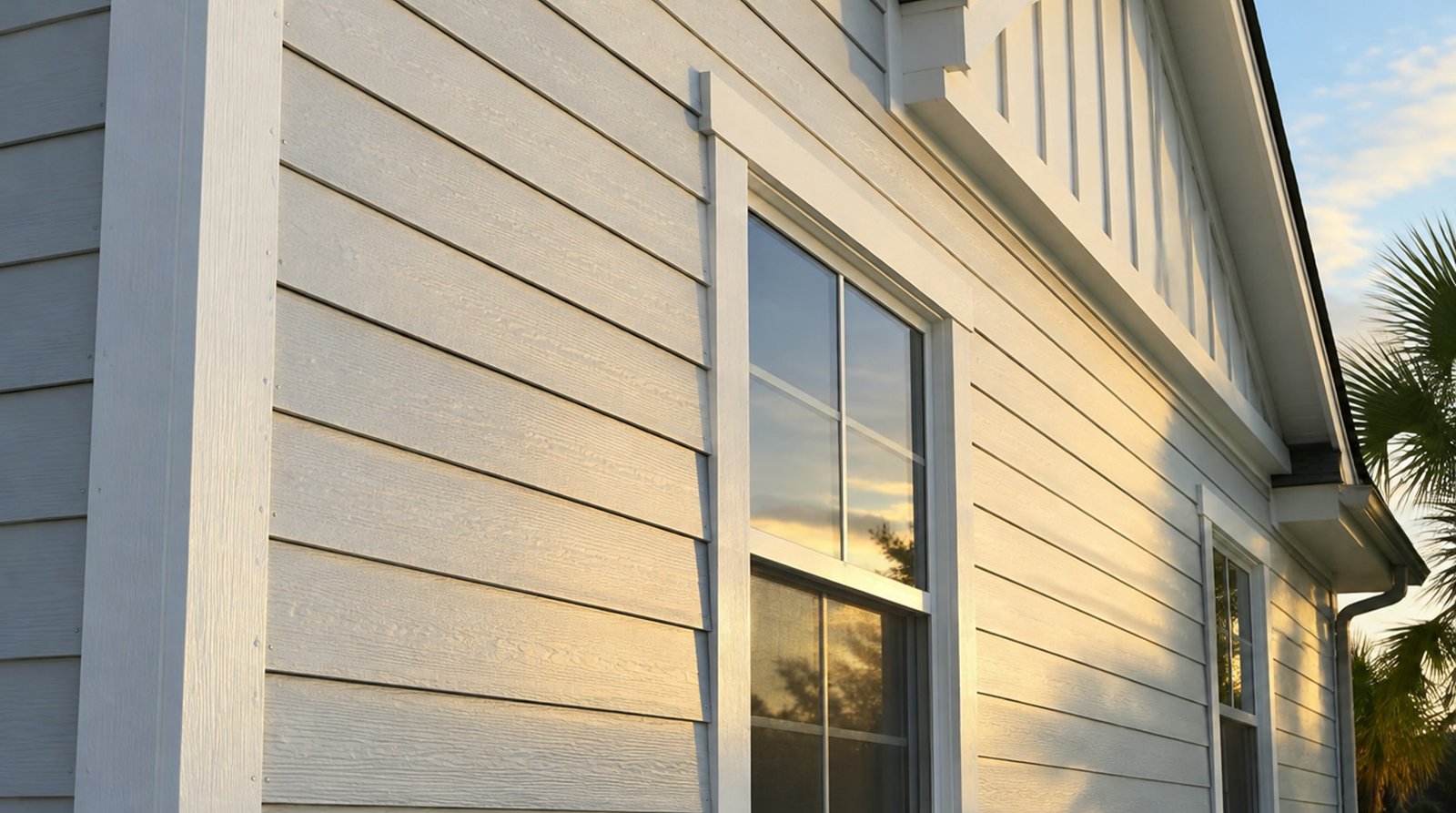
Image described: Fiber cement board and batten siding on a coastal home with deep shadow lines
Every siding comparison you will read was written for somewhere else. Most of them are fine advice in Ohio. On the Grand Strand there are three conditions that change the answer, and none of them show up in a national buying guide.
The three things this coast does to siding
Humidity. Relative humidity here runs roughly 75 to 85 percent year round. Materials that absorb moisture swell, cup and hold mold. Materials that do not, do not.
UV. We are far enough south that sun exposure is harsher than it is inland, and it is the thing that fades color and makes vinyl brittle over time.
Wind. Parts of Horry and Georgetown County sit in a hurricane zone where jurisdictions commonly require cladding rated to 130 mph or higher. That rating is about the product and the fastening pattern together.
Where fiber cement wins
Fiber cement, which most people call Hardie after the biggest manufacturer, is cement, sand and cellulose. It does not swell with humidity. It gives insects nothing to eat. It holds paint far longer than wood in this UV, and it is heavy enough that wind does not lift it the way it lifts a light panel.
It is also slower and more expensive to install. It is heavier to handle, it needs specific cutting and fastening, and cut edges have to be treated. Some contractors will steer you away from it for exactly that reason, and it is worth knowing that is why.
Where vinyl is still the right answer
We are not going to pretend vinyl is a bad product, because it is not. It costs meaningfully less to buy and to install. It never needs painting. On a rental you plan to sell in five years, on a budget that is genuinely tight, or on an elevation that gets very little sun and weather, vinyl does the job.
What vinyl does badly here is heat and wind. It expands and contracts more than fiber cement, which is why it is hung loose rather than nailed tight, and that same looseness is why one lifted panel in a storm tends to take its neighbors with it. It also fades, and faded vinyl cannot be painted back the way fiber cement can.
The part nobody quotes
Whichever you choose, what is behind the siding matters more than the siding. House wrap that was never lapped correctly, or sheathing that has been quietly wet for six years, will fail under either product.
This is why we open a section of the wall before we quote a siding job. A number written from the street is a guess, and the difference between the guess and the truth is usually rotten sheathing.
What we would tell a neighbor
If you are staying in the house, put fiber cement on the elevations that take the weather, usually the ones facing the water, and it will outlive the decision. If you are on a tight budget or a short horizon, vinyl on a properly corrected wrap is an honest choice and we will install it without trying to talk you out of it.
What we would not do is put either one over sheathing nobody has looked at.
Related